
news
E-QUALITY publishes two key WP3 reports to strengthen Quality Assurance in Higher Education
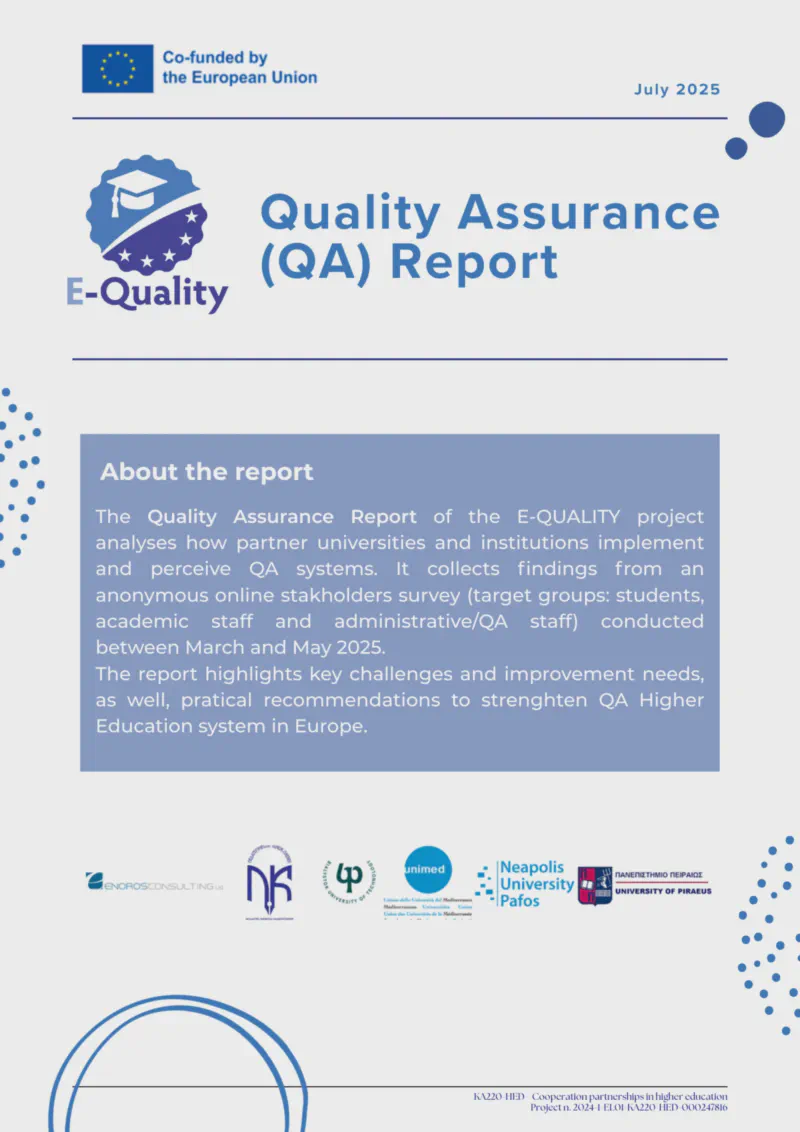
The E-QUALITY partnership has released two major outputs under Work Package 3 (WP3): the General Quality Assurance Report and the General Report on Best Practices on Quality Assurance. Together, these publications mark an important step toward a shared, stakeholder-driven understanding of quality in higher education—and translate that evidence into practical solutions that will inform the E-QUALITY Platform and the upcoming training pathway for QA professionals.
Building quality standards from real stakeholder perspectives
WP3 focuses on collecting and comparing perspectives from the main actors involved in university quality assurance systems—students, academic staff, QA coordinators, and administrative employees—so that quality standards can be defined in a way that is both robust and applicable across different national and institutional contexts.
To achieve this, WP3 combines desk and field methods, including: literature and practices collection, interviews with key informants, and an international survey addressed to the project’s target groups. This approach supports WP3’s broader objective: aligning the future structure of the E-QUALITY Platform with the real needs, expectations, and operational realities of QA services.
Evidence from the Quality Assurance Survey Report
The General Quality Assurance Report presents findings from a multi-stakeholder survey conducted online between March and May 2025 across the partnership. The survey gathered responses from 243 students, 87 university teachers, and 73 administrative staff/quality experts, exceeding the minimum targets set by the project.
Key cross-cutting messages emerging from the data include:
- Students want to be involved—if they are informed and empowered. Reported recommendations include awareness campaigns on how QA affects students’ futures, a student quality club, and an annual “Quality Day” to make QA more visible and participatory. Students also reported high participation in course evaluations and strong interest in QA-related training opportunities.
- Teaching staff call for more practical, tech-enabled QA processes. Faculty feedback emphasizes improving practical approaches to quality, strengthening communication between faculties, and increasing the use of digital tools to support QA.
- QA coordinators and administrators highlight training, infrastructure, and communication as priorities. Respondents point to the value of regular updates to the QA system, stronger technological infrastructure, and clearer cross-unit communication—alongside risk management and error prevention supported by digital monitoring tools.
Complementing the survey, the General Report on Best Practices on Quality Assurance gathers 25 Good Practices contributed by partners - University of Piraeus Research Centre, UNIMED - Mediterranean Universities Union, St. Cyril and St. Methodius University of Veliko Tarnovo, Bialystok University of Technology, Neapolis University Pafos, and Enoros Consulting Limited.
What’s next: shaping the E-QUALITY Platform and training offer
The two reports converge in a clear direction: a successful QA transformation requires shared standards, continuous capacity-building, and tools that make quality work simpler, more transparent, and more meaningful for everyone involved. In response, WP3 results will directly feed the design of the E-QUALITY Platform and its learning components.
By grounding platform development in both evidence (survey results) and practice (validated good examples), E-QUALITY continues to move beyond compliance toward a lasting culture of quality in higher education—shared, participatory, and fit for the evolving needs of European universities.